Showing posts with label Lupine Publishers LLC. Show all posts

Wednesday, 12 February 2020

Lupine Publishers| Multi-Purpose Functional Materials Based on Thermosensitive Poly (N-vinylcaprolactam)

Lupine Publishers| Journal of Nano medicine


Introduction

Worldwide mortality rates have experienced a remarkable decline in recent decades, a trend that projects to continue over the next years, increasing the older population. As a result of increased life expectance, people are living more and better. Virtually every country in the world is experiencing growth in the number and proportion of elderly people. Dealing with the population growth, its aging and treatments of typical health problems found in older people are just some of urgent demands for near future. Particularly, several developing countries are experimenting a fast transition from young to old population, which is affecting their national health system and families budgets. Getting older bring senior health challenges.
Typical chronical diseases are arthritis, circulatory problems, cancer, osteoporosis, diabetes, problems of locomotion due to trauma and falls, as well as oral healthy. On the other hand, “lifestyle” diseases related to tobacco and alcohol abuse accounts for a rising share of deaths of relatively young people. Additionally, non communicable diseases, such as circulatory-system ailments, cancers, and psychiatric disorders, are expected to replace infectious diseases and child malnutrition as the greatest contributors to the global disease burden [1]. During the last decade, nanotechnology revolutionized human life in aspects never though by Feynman in its famous conference “There´s plenty of room at the bottom” [2]. The possibility to induce, enhance or modify properties of materials used in our ordinary life or in incredibly sophisticated applications opened a new road for creative technologies in materials science, chemistry and medicine.
Nanotechnology is one of the promising fields for engendering new applications in energy, environmental and health, which represent three of the greatest challenges facing humanity in this century. By assembling materials at the nano scale, exceptional properties improvements can be obtained, which play a strategic role in our technological society3touching aspects that are quite far from our eyes. Selective biosensors for cancer cells, smart nano composites for transport and drug delivery, functional nanoparticles for cancer therapy and image, scaffolds for tissue engineering, and nano structured materials for implants, bones prosthesis and dental uses, can be used as good examples of effective bio functional materials based on nanotechnology.
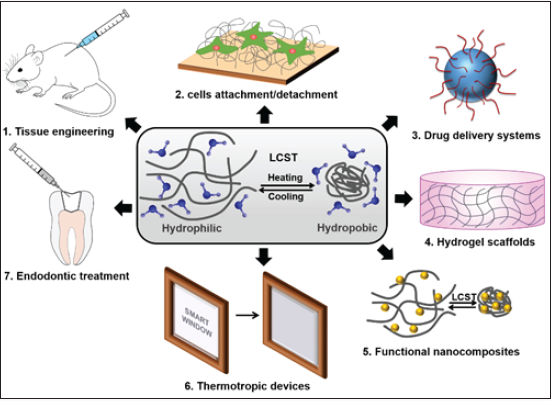
The design and discovery of new functional materials involve a mixture of clever chemical intuition, rational assessment of the technical requirements, and substantial experimental efforts [4]. The complete development cycle, from scientific concept to marketing practice, takes time and requires a huge amount of resources. Once the material is sufficiently understood, new applications in different commercial fields is just a matter of creative and boldness. For instance, we successfully developed a nontoxic thermosensitive hydrogel based on poly (N-vinylcaprolactam) with a lower critical solution temperature (LCST) (Figure 1) [5]. This hydrogel (also referred to as PNVCL) exhibits a phase transition near the body temperature from a hydrophilic and water-soluble phase at low temperatures to an insoluble hydrophobic state when heated.
Its cyto compatibility and fast response to temperature stimuli allow its use as injectable hydrogel for tissue engineering [1]. Changes in the PNVCL molecular weight and concentration enabled the development of hydrogels with tunable mechanical properties and fast gelation times to support cartilage specific extracellular matrix production both in vitro and in vivo. PNVCL can also be obtained by initiated chemical vapor deposition on substrates for cell sheet engineering, excluding the use of conventional enzymatic treatments [2]. [6]Thermosensitive hydrogels are also suitable for drug delivery systems, including those modified with magnetic nanoparticles against pathogenic oral bio films, usually employing well-known antibiotics such as chlorhexidine but also some flavonoids and antimicrobial peptides [3]. The replacement of injured or malfunctioning natural organs or tissues by a natural substitute requires transplantation of an acceptable, healthy substitute.

Figure 1: Multi-purpose functional materials can be applied in different uses. Thermosensitive poly (N-vinylcaprolactam), for example, has been used as injectable hydrogel for tissue engineering (1), as substrates for cell growth (2), in drug delivery systems (3), as scaffolds to fabricate ‘bio artificial’ or ‘bio hybrid’ synthetic organs (4), as functional nano composites (5), smart windows (6), and for dentistry treatments (7).
Lupinepublishers-openaccessjournals-Nanotechnology-nanomedicine
According to World Health Organization,7 126.670 of solid organs were transplanted in 2014, which is less than 10% of global needs. Almost 25% of all transplants occurred in USA, followed by China (7,9 %), Brazil (6,2 %) and France (4,5 %).In fact, hydrogels can be used for engineered tissue scaffolds or to fabricate ‘bio artificial’ or ‘bio hybrid’ synthetic organs due to their unique compositional and structural similarities to the natural extracellular matrix to repair organs injuries and regenerate organs [4]. Beyond complexes uses for health, thermosensitive hydrogels can be modified using functional nanoparticles, such as noble metal, magnetic ferrites, bioactive glasses or porous silica for different purposes, from drug transport and delivery, coatings for packaging, biosensors or optical applications [5], which include passive and active thermo tropic devices used in smart windows [6].
Finally, special attention should be dedicated for dental applications against C. albicans and S. mutans biofilms, cariogenic species generally responsible for dental caries. Perhaps the greatest challenge to obtain effective multi-purpose functional materials is to build a multidisciplinary collaboration network of chemists, engineers, dentists, biologists, physicians from academy but including also marketing experts and professionals from industry. Innovative ideas and creative solutions are at interfaces among specialties.


Friday, 31 January 2020

Lupine Publishers| Nano Toxicity: Due to Drug Delivery and Environmental Exposure


Lupine Publishers | Journal of Nanomedicine

Abstract
Go to
Nanotechnology is undergoing a vast expansion in materials science, Research and Development. Nano scientists are focusing on synthesis and development of nanoparticles, nanomaterials, and bio nano composite materials. The drug delivery is also a recent development where in bio nano materials are being used for diagnosis of the various diseases. The synthesis of nanomaterials at large scale causes health risk due to the exposure via inhalation, skin contacts and ingestion; based on the characterisation of bio nano materials. The use of bio nanomaterials in drug delivery as well as the environment exposure during the large-scale synthesis of nanomaterials, the bio nanomaterials into human body.The exact mechanisms, chemical reactivity and enzymatic reaction is not well understood, documented, and studied. Therefore, the intake bio nanomaterials via drug delivery or environment exposure amounts to health risk and need to be studied in detail.
Introduction
Go to
Nanosciences and Nanotechnology is the study and use of nanomaterials falls in the range of 0.1nm to 100nm which corresponds to 0.2nm- water molecule, 7nm-haemoglobin, 10-100nm - virus, -1μm - microbial cells and >2μm - protozoa. The synthesized and developed nanoparticles, nanomaterials, and Bio nanomaterials are being used in various fields. The recent advances in the field of material sciences include the synthesis of Bio nano material for use in drug delivery. Bio nanotechnology companies are designing drugs for various diseases such as heart disease, kidney stones, and cancer cosmetic generic products using a short fragment of DNA as a new type of drugs. These drugs are assembled in nano chips and as nanoparticles for delivering into human body and are effective in using the sick/diseased and healing the injuries. Bio nano products are diverged as bio chip and Nano medicine, bio nanotechnology products which include Nano medicine, nano material, micro detectors, Nano sensors and herbal medicine [1].
Drug nano crystals are particles made from 100% drug; typically, surfactants or polymeric steric stabilizers stabilize them. These particles possess a 100% drug loading in contrast to matrix nanoparticles consisting of a polymeric matrix (polymeric nanoparticles or a lipidic matrix i.e. Nano emulsions, liposomes | or lipid nanoparticles. Thus, the high loading makes them very efficient in transporting drug to or into cells, reaching a sufficiently high therapeutic concentration for the pharmacological effect [4-8].
Health Risk
The scientific evidence demonstrates the potential for nano material to be toxic to the humans or the environment; therefore, synthesis of nanoparticles and bio nano composites and their use causes health risk due to intake – drug delivery and environment exposure that need to be studied before making the wider application of bio nanomaterials. The smaller a particle, the greater it’s surface area to volume ratio and the higher its chemical reactivity and biological activity. The extremely small size of nanomaterials also means that they are more rapidly taken up by the human body than larger sized particles. Nanomaterials can enter into the body through inhalation, ingestion or skin contacts. Nanomaterials are able to cross biological membranes and access cell tissues and organs. The greater chemical reactivity of nanomaterials results in increased production of reactive oxygen species, including free radicals. Reactive oxygen species and free radical product is one of the primary mechanisms of nanoparticles toxicity. Other properties of nanomaterials that influence toxicity include chemical composition, shape, surface structure, surface charge, aggregation and solubility and the presence or absence of functional groups of other chemicals [9-11].
Mode of entry of Nano particle:
The Nano particle ranges between 1nm to 100nm which can enter into the body through inhalation, skin contact and ingestion. The synthesis of nano particle at large scale will cause exposure through these routes.
a. Inhalation:
Inhalation is the most important route for the intake of airborne nano particle. Depending on the size, particles are trapped in mucous layer and alveoli. For nano particle the position is more complex. Particles of 1 micron diameter or more tend to be deposited, but only those less than 7.0 microns, deposit deep inside the lungs. Those more than 7.0 micron deposit in the conductive airways. Particles in size less than 0.1 micron deposit in the alveolus. Most of the particles between 0.1 and 0 micron size are exhaled. The pattern and depth of breathing and irritant effects of inhaled material may alter the deposition of particles and may remain permanently within the lung tissue.
b. Skin contact:
The large scale synthesis of nano particles in industry for wider application will cause exposure of nano particle through skin absorption; the penetration of nano particle through skin occurs via lipids and dissolved material. Lipid solubility and molecular size are the most important factors, so that higher lipid solubility and small molecular size enhance penetration through skin. Abrasion and irritation also encourage penetration. This route is particularly important for organic solvents and can occur in a number of ways.
(i) Direct absorption through wounds or abrasions.
(ii) Degreasing of the skin followed by absorption of the degreasing agents.
(iii) Degreasing of the skin allowing absorption of other chemicals.
(iv) Sensitisation, local and general.
b. Skin contact:
Ingestion of nano materials during the process of synthesis may result from the contaminated object into the mouth. Ingestion of toxic substance along with food in the workroom occurs where housekeeping is not good, or where workers are careless to nano particles in their clothes, or wash their hands with soap. If the toxic nano dust swallowed with food or saliva is not soluble in body fluids, it is eliminated directly through the intestinal tract. Toxic materials that are readily soluble in body fluids are absorbed in the digestive system and circulated by the blood. Compared with inhalation and skin absorption, ingestion, plays a minor role in the absorption of toxic materials in industries [2-3].
Toxicity of Nanomaterials
The intake of bio nanomaterials in human body undergoes biochemical mechanism and enzymatic interaction and height cause. Toxicity of nano particles depending on nature of chemical used for the synthesis, type of precursor, concentration of precursor, duration of exposure, personal susceptibility, and mode of entry, size of nano particle, environmental factors, and threshold limit value.
Conclusion
Go to
The drug delivery is one of the routes for treating diagnosis using the bio nano material. The exact fate of bio chemical reactivity, enzymatic interaction is not well understood and studied and might lead to toxicity similar to that of exposure of nano material through inhalation, skin contact and ingestion. Therefore, synthesis of nano particle, bio nano composite, their use and environmental exposure need to be studied before making the wider application for the diagnosis of disease using bio nano materials. The detail of physico chemical characteristics, stability of nanomaterials and their specification to target organs as human body system need data base scientific research.

For more Lupine Publishers Open Access Journals Please visit our website:


Follow on Twitter   :  https://twitter.com/lupine_online

Tuesday, 11 June 2019

Lupine Publishers Editor Guidelines

  •     Editor Guidelines The main epigram of Lupine Publishers is to spread scientific knowledge globally by publishing quality articles in their open access journals. The credibility of published articles completely depends on the effective peer review process; Hence, editors are the chief support for Lupine Publishers. The Editorial board members of Lupine are responsible to make it as quality manuscript publisher which are received from authors on various subject areas. Roles and Responsibilities:  Actively look for the views of associate editors, authors, readers, reviewers and editorial board members about ways of improving their journal's content.  Reputation of our group is enhanced by the presence of eminent editors. They also must endeavor to set higher standards for the journal whenever possible.  Sustain initiatives to educate researchers and young scholars about publication policies and ethics.  Editorial board members are most welcome to give their valuable suggestions for organizational progress.  Editors can review submitted manuscripts based on their feasible time, if time does not allow reviewing the manuscript, editors can suggest other reviewers.  Editors will look after any confidential data regarding the task. If the author has used information of certain individuals,specifically in any of his medical or scientific records, the editorial Team must look for written consent
  • from the individual,for the record to qualify for publishing.  Grabbing editorial decisions at the right time and communicating in a clear manner.  The validity of the scientific facts stated must be checked and the criticism of the manuscript should be left open for all to decide.  The editorial board members must assure that published content is original.The reliability of the author's work is a must, so there must be proper citation and the original source of the content should be named.  The final decision regarding modification,acceptance, or rejection of a manuscript rests solely with the editor. Benefits:  Editors can be promoted as senior editor and executive editor in the concerned journal based on their active participation and also based on their experience.  Editors will be given highest priority in all the events that are organized by Biomedical Journal.  Based on their kind contributions and their efficiency, there is a chance to serve as a prominent member of the advisory board.  After one year of due course, Editor-in-Chief will be announced for every journal based on their active participation,expertise in the field, contribution towards the Journal and also their scientific contributions.  The review comments that are given by the editors will be strictly followed after which the authors will be requested

  • to modify their manuscript according to the editor’s suggestions.  We promote all the articles of the Editors that are published in our journals, in various social networking groups from our end, increasing visibility for their works.  Our journals consider Editorials as a note to the young researchers and scholars.  Editors shall be honored in position as Chair/Co-Chair for any conferences organized by us and also the fee will be waived. Interested to be an Editor for Lupine Open Access Journal? If you are interested to become the editor for our LupinePublishers - open access journals, kindly mail us your Complete Resume along with the journal of interest to info@lupinepublishers.com. We will respond to you within 24- 48 hours. Or you can even register yourself by filling the Online Registration form Lupine Publishers, withstands constant support for the editors who play prominent role in promoting Open Access system via our Publication policy and help us in facilitating our mission of promoting the Scientific Research Publication amongst the Research community.
  • https://www.slideshare.net/LupinePublishers/lupine-publishers-editor-guidelines
  • Friday, 7 June 2019

    Lupine Publishers- Opinion Stage

    Lupine Publishers
    Lupine Publishers  is a world’s leading Online Publishing repository, a genuine publisher with quality medical journals. Lupine Publishers  peer reviewed publisher is a multidisciplinary, scholarly Open Access publisher focused on Genetic, Biomedical and Remedial missions in relation with Technical Knowledge as well. Lupine Publishers  Online Open Access Publisher, craves to select ground-breaking research based on modernism, aptness, scientific connotation, prospective spectator’s interests, etc. Lupine Publishers Online Open Access Publisher endeavor to provide by far and liberally accessible belvedere to researchers and practitioners in support of their novel and valuable ideas. Lupine Publishers  Online Open Access Publisher already have 2000+ Editorial Board members along with 5000+ Published articles with them. Lupine Publishers Online Open Access journals maintains a scrupulous, methodical, fair peer review System. Besides, quality control is riveted in each step of the publication process.

    Lupine Publishers, strictly follows open access policy: Open access policies are part of rapidly growing researches in academia to enhance and encourage the new modes and techniques of scholarly publication by providing worldwide free access. Members of universities, schools and departments are establishing open access policies to make their research and scholarship more accessible to scholars, educators, policymakers, students and citizens worldwide.

    The only motto of Lupine Publishers  Open access Publisher is accelerating the scientific and technical research papers, considering the importance of technology and the human health in the advanced levels and several emergency medical and clinical issues associated with it, the key attention is given towards biomedical research. Thus, Lupine Publishers  asserting the requirement of a common evoked and enriched information sharing platform for the craving readers.

    Lupine Publishers is such a unique platform to accumulate and publicize scientific knowledge on science and related discipline. Lupine Publishers  multidisciplinary open access publisher (www.lupinepublishers.com)  is rendering a global podium for the professors, academicians, researchers and students of the relevant disciplines to share their scientific excellence in the form of an original research article, review article, case reports, short communication, e-books, video articles, etc.

    Lupine Publishers has quality journals which are self supporting, with no dependency on any other external sources (like universities, centers) for funds and strives for the best and enhanced quality publications competes the world wide open access publishing market.

    Lupine Publishers  always rely on the support from the members of the Lupine Publishers  family that is relevantly their Authors, Editorial Committee members, advisory board, Reviewers Board and all the technical support teams all over the globe. Lupine Publishers  trust in the reciprocated coordination and cooperation in terms of sharing the scientific knowledge of individuals and Groups of Research centers/areas will in turn educates and provokes in advanced researches. In this case Lupine Publishers like to act as a media that anchors in the transformation of information in the form of global online publication.

    Lupine Publishers likes to bring world latest concept of open access video articles of research work at ease and cost-efficient manner. Lupine Publishers  aim to develop the integrated illustration approach to educational researchers and practitioners to encourage innovations and new research frontiers in scientific field. Lupine Publishers provides advance platform for researchers for making their research work live and exemplify investigational visualization to the world. Lupine Publishers also helps researchers to demonstrate their work by video to all young researchers, as this helps authors to get rapid acquaintance among their research community within short span of time. Lupine Publishers invite video research articles in all diverse fields of Medical, Life Science, Health Care, Pharma, and other groups for publication in their Journals.

    Lupine Publishers also accepts E-books that are written by scholars and influences the learning practice around the world. Lupine Publishers,  believes that E-books offer many potential benefits, to access when and where you want to read. Lupine Publishers  a great way to demonstrate knowledge in a creative way and is much more visually appealing than a white paper. The e-book has become the current standard form to have the research work available to the users. Lupine Publishers  offers high quality of PDF formats for their scholars to have their work available to the world.

    Lupine Publishers , lightening fast lookup of the required information can now find through e-books as, it’s the hand library available of the users upon one button. Lupine Publishers  delivers high quality of e-prints that can be displayed in any electronic device. E-Books are the ones where every individual can afford, as they are freely available with Lupine Publishers. In Lupine Publishers, e-Books are embedded with a variety of multi-media elements which are not available with traditional books. Also, audio and video can be implanted to make reading comfortable while accessing the published articles.

    Lupine Publishers provides article reprints with an aim to broadcast the research work in affordable and quality paper. Lupine Publishers,  indeed providing reprints is to explore the research work to the world in the format the user need.

    Lupine Publishers  reprints in two ways: Hard Copy: Lupine Publishers, provide reprints with high quality & specially designed covers along with the journal name & logo on every page. Also, Lupine Publishers  provide customization option for cover Image. Or reprints will the mirror image of your articles.

    Electronic copy: E-prints of Lupine Publishers are the electronic copies of article in PDF format. E-prints are print-enabled and allow users to print PDF for their use. The provided PDF link can be emailed or burned onto CD-ROMs. 


    Friday, 31 May 2019

    What is the role of Editors in Lupine Publishers?

    Editor Guidelines
    The main epigram of Lupine Publishers is to spread scientific knowledge globally by publishing quality articles in their open access journals. The credibility of published articles completely depends on the effective peer review process; Hence, editors are the chief support for Lupine Publishers. The Editorial board members of Lupine are responsible to make it as quality manuscript publisher which are received from authors on various subject areas.
    Roles and Responsibilities:
    • Actively look for the views of associate editors, authors, readers, reviewers and editorial board members about ways of improving their journal's content.
    • Reputation of our group is enhanced by the presence of eminent editors. They also must endeavor to set higher standards for the journal whenever possible.
    • Sustain initiatives to educate researchers and young scholars about publication policies and ethics.
    • Editorial board members are most welcome to give their valuable suggestions for organizational progress.
    • Editors can review submitted manuscripts based on their feasible time, if time does not allow reviewing the manuscript, editors can suggest other reviewers.
    • Editors will look after any confidential data regarding the task. If the author has used information of certain individuals, specifically in any of his medical or scientific records, the editorial Team must look for written consent from the individual, for the record to qualify for publishing.
    • Grabbing editorial decisions at the right time and communicating in a clear manner.
    • The validity of the scientific facts stated must be checked and the criticism of the manuscript should be left open for all to decide.
    • The editorial board members must assure that published content is original. The reliability of the author's work is a must, so there must be proper citation and the original source of the content should be named.
    • The final decision regarding modification, acceptance, or rejection of a manuscript rests solely with the editor.
    Benefits:

    • Editors can be promoted as senior editor and executive editor in the concerned journal based on their active participation and also based on their experience.
    • Editors will be given highest priority in all the events that are organized by Biomedical Journal.
    • Based on their kind contributions and their efficiency, there is a chance to serve as a prominent member of the advisory board.
    • After one year of due course, Editor-in-Chief will be announced for every journal based on their active participation, expertise in the field, contribution towards the Journal and also their scientific contributions.
    • The review comments that are given by the editors will be strictly followed after which the authors will be requested to modify their manuscript according to the editor’s suggestions.
    • We promote all the articles of the Editors that are published in our journals, in various social networking groups from our end, increasing visibility for their works.
    • Our journals consider Editorials as a note to the young researchers and scholars.
    • Editors shall be honored in position as Chair/Co-Chair for any conferences organized by us and also the fee will be waived.

    Tuesday, 28 May 2019

    Nanomedicine open access journal- Lupine Publishers


    Nanotechnology employs substances comprising particles of one to 100 nanometres (nm) in size [1,2], in other words, finely powdered ‘dusts’. These are generally manufactured, and do not occur in nature, although natural materials of small particle size are included in the definition.

    Nanomaterials reputedly display ‘unique phenomena’, offering economic potential through manipulation of nanoparticles for novel applications [3]. Hence nanotechnology requires study and ‘fine-tuning’ of atomic, molecular and macro-molecular materials, whose properties may vary from those manifested by materials in ‘bulk’ dimensions [4]. These aims imply existing (and growing) expertise regarding the required ‘fine-tuning’ processes and suggest that manipulating nano-dusts will create benefits for society, in technological and, for instance, medical, applications.

    https://lupinepublishers.com/nano-science-nano-technology-journal/fulltext/understanding-parallels-between-homeopathy-and-nanomedicine.ID.000124.php

    For more Lupine Publishers Open Access Journals Please visit our website: http://www.lupinepublishers.com/


    Lupine Publishers: Lupine Publishers | Post Endodontic Pain Reduction...

    Lupine Publishers: Lupine Publishers | Post Endodontic Pain Reduction... : Lupine Publishers | Journal of Otolaryngology Research Impact Fac...