Showing posts with label journal of Nano-medicine. Show all posts

Wednesday, 12 February 2020

Lupine Publishers| Multi-Purpose Functional Materials Based on Thermosensitive Poly (N-vinylcaprolactam)

Lupine Publishers| Journal of Nano medicine


Introduction

Worldwide mortality rates have experienced a remarkable decline in recent decades, a trend that projects to continue over the next years, increasing the older population. As a result of increased life expectance, people are living more and better. Virtually every country in the world is experiencing growth in the number and proportion of elderly people. Dealing with the population growth, its aging and treatments of typical health problems found in older people are just some of urgent demands for near future. Particularly, several developing countries are experimenting a fast transition from young to old population, which is affecting their national health system and families budgets. Getting older bring senior health challenges.
Typical chronical diseases are arthritis, circulatory problems, cancer, osteoporosis, diabetes, problems of locomotion due to trauma and falls, as well as oral healthy. On the other hand, “lifestyle” diseases related to tobacco and alcohol abuse accounts for a rising share of deaths of relatively young people. Additionally, non communicable diseases, such as circulatory-system ailments, cancers, and psychiatric disorders, are expected to replace infectious diseases and child malnutrition as the greatest contributors to the global disease burden [1]. During the last decade, nanotechnology revolutionized human life in aspects never though by Feynman in its famous conference “There´s plenty of room at the bottom” [2]. The possibility to induce, enhance or modify properties of materials used in our ordinary life or in incredibly sophisticated applications opened a new road for creative technologies in materials science, chemistry and medicine.
Nanotechnology is one of the promising fields for engendering new applications in energy, environmental and health, which represent three of the greatest challenges facing humanity in this century. By assembling materials at the nano scale, exceptional properties improvements can be obtained, which play a strategic role in our technological society3touching aspects that are quite far from our eyes. Selective biosensors for cancer cells, smart nano composites for transport and drug delivery, functional nanoparticles for cancer therapy and image, scaffolds for tissue engineering, and nano structured materials for implants, bones prosthesis and dental uses, can be used as good examples of effective bio functional materials based on nanotechnology.
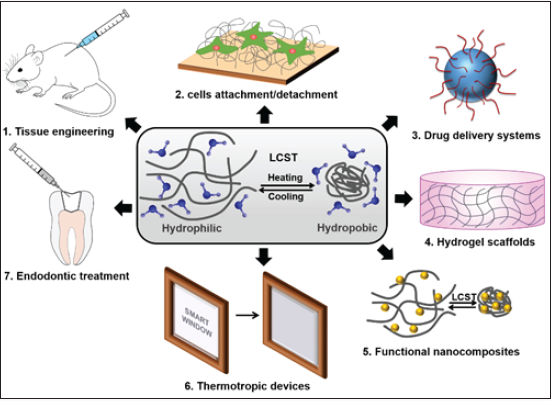
The design and discovery of new functional materials involve a mixture of clever chemical intuition, rational assessment of the technical requirements, and substantial experimental efforts [4]. The complete development cycle, from scientific concept to marketing practice, takes time and requires a huge amount of resources. Once the material is sufficiently understood, new applications in different commercial fields is just a matter of creative and boldness. For instance, we successfully developed a nontoxic thermosensitive hydrogel based on poly (N-vinylcaprolactam) with a lower critical solution temperature (LCST) (Figure 1) [5]. This hydrogel (also referred to as PNVCL) exhibits a phase transition near the body temperature from a hydrophilic and water-soluble phase at low temperatures to an insoluble hydrophobic state when heated.
Its cyto compatibility and fast response to temperature stimuli allow its use as injectable hydrogel for tissue engineering [1]. Changes in the PNVCL molecular weight and concentration enabled the development of hydrogels with tunable mechanical properties and fast gelation times to support cartilage specific extracellular matrix production both in vitro and in vivo. PNVCL can also be obtained by initiated chemical vapor deposition on substrates for cell sheet engineering, excluding the use of conventional enzymatic treatments [2]. [6]Thermosensitive hydrogels are also suitable for drug delivery systems, including those modified with magnetic nanoparticles against pathogenic oral bio films, usually employing well-known antibiotics such as chlorhexidine but also some flavonoids and antimicrobial peptides [3]. The replacement of injured or malfunctioning natural organs or tissues by a natural substitute requires transplantation of an acceptable, healthy substitute.

Figure 1: Multi-purpose functional materials can be applied in different uses. Thermosensitive poly (N-vinylcaprolactam), for example, has been used as injectable hydrogel for tissue engineering (1), as substrates for cell growth (2), in drug delivery systems (3), as scaffolds to fabricate ‘bio artificial’ or ‘bio hybrid’ synthetic organs (4), as functional nano composites (5), smart windows (6), and for dentistry treatments (7).
Lupinepublishers-openaccessjournals-Nanotechnology-nanomedicine
According to World Health Organization,7 126.670 of solid organs were transplanted in 2014, which is less than 10% of global needs. Almost 25% of all transplants occurred in USA, followed by China (7,9 %), Brazil (6,2 %) and France (4,5 %).In fact, hydrogels can be used for engineered tissue scaffolds or to fabricate ‘bio artificial’ or ‘bio hybrid’ synthetic organs due to their unique compositional and structural similarities to the natural extracellular matrix to repair organs injuries and regenerate organs [4]. Beyond complexes uses for health, thermosensitive hydrogels can be modified using functional nanoparticles, such as noble metal, magnetic ferrites, bioactive glasses or porous silica for different purposes, from drug transport and delivery, coatings for packaging, biosensors or optical applications [5], which include passive and active thermo tropic devices used in smart windows [6].
Finally, special attention should be dedicated for dental applications against C. albicans and S. mutans biofilms, cariogenic species generally responsible for dental caries. Perhaps the greatest challenge to obtain effective multi-purpose functional materials is to build a multidisciplinary collaboration network of chemists, engineers, dentists, biologists, physicians from academy but including also marketing experts and professionals from industry. Innovative ideas and creative solutions are at interfaces among specialties.


Friday, 31 January 2020

Lupine Publishers| Nano Toxicity: Due to Drug Delivery and Environmental Exposure


Lupine Publishers | Journal of Nanomedicine

Abstract
Go to
Nanotechnology is undergoing a vast expansion in materials science, Research and Development. Nano scientists are focusing on synthesis and development of nanoparticles, nanomaterials, and bio nano composite materials. The drug delivery is also a recent development where in bio nano materials are being used for diagnosis of the various diseases. The synthesis of nanomaterials at large scale causes health risk due to the exposure via inhalation, skin contacts and ingestion; based on the characterisation of bio nano materials. The use of bio nanomaterials in drug delivery as well as the environment exposure during the large-scale synthesis of nanomaterials, the bio nanomaterials into human body.The exact mechanisms, chemical reactivity and enzymatic reaction is not well understood, documented, and studied. Therefore, the intake bio nanomaterials via drug delivery or environment exposure amounts to health risk and need to be studied in detail.
Introduction
Go to
Nanosciences and Nanotechnology is the study and use of nanomaterials falls in the range of 0.1nm to 100nm which corresponds to 0.2nm- water molecule, 7nm-haemoglobin, 10-100nm - virus, -1μm - microbial cells and >2μm - protozoa. The synthesized and developed nanoparticles, nanomaterials, and Bio nanomaterials are being used in various fields. The recent advances in the field of material sciences include the synthesis of Bio nano material for use in drug delivery. Bio nanotechnology companies are designing drugs for various diseases such as heart disease, kidney stones, and cancer cosmetic generic products using a short fragment of DNA as a new type of drugs. These drugs are assembled in nano chips and as nanoparticles for delivering into human body and are effective in using the sick/diseased and healing the injuries. Bio nano products are diverged as bio chip and Nano medicine, bio nanotechnology products which include Nano medicine, nano material, micro detectors, Nano sensors and herbal medicine [1].
Drug nano crystals are particles made from 100% drug; typically, surfactants or polymeric steric stabilizers stabilize them. These particles possess a 100% drug loading in contrast to matrix nanoparticles consisting of a polymeric matrix (polymeric nanoparticles or a lipidic matrix i.e. Nano emulsions, liposomes | or lipid nanoparticles. Thus, the high loading makes them very efficient in transporting drug to or into cells, reaching a sufficiently high therapeutic concentration for the pharmacological effect [4-8].
Health Risk
The scientific evidence demonstrates the potential for nano material to be toxic to the humans or the environment; therefore, synthesis of nanoparticles and bio nano composites and their use causes health risk due to intake – drug delivery and environment exposure that need to be studied before making the wider application of bio nanomaterials. The smaller a particle, the greater it’s surface area to volume ratio and the higher its chemical reactivity and biological activity. The extremely small size of nanomaterials also means that they are more rapidly taken up by the human body than larger sized particles. Nanomaterials can enter into the body through inhalation, ingestion or skin contacts. Nanomaterials are able to cross biological membranes and access cell tissues and organs. The greater chemical reactivity of nanomaterials results in increased production of reactive oxygen species, including free radicals. Reactive oxygen species and free radical product is one of the primary mechanisms of nanoparticles toxicity. Other properties of nanomaterials that influence toxicity include chemical composition, shape, surface structure, surface charge, aggregation and solubility and the presence or absence of functional groups of other chemicals [9-11].
Mode of entry of Nano particle:
The Nano particle ranges between 1nm to 100nm which can enter into the body through inhalation, skin contact and ingestion. The synthesis of nano particle at large scale will cause exposure through these routes.
a. Inhalation:
Inhalation is the most important route for the intake of airborne nano particle. Depending on the size, particles are trapped in mucous layer and alveoli. For nano particle the position is more complex. Particles of 1 micron diameter or more tend to be deposited, but only those less than 7.0 microns, deposit deep inside the lungs. Those more than 7.0 micron deposit in the conductive airways. Particles in size less than 0.1 micron deposit in the alveolus. Most of the particles between 0.1 and 0 micron size are exhaled. The pattern and depth of breathing and irritant effects of inhaled material may alter the deposition of particles and may remain permanently within the lung tissue.
b. Skin contact:
The large scale synthesis of nano particles in industry for wider application will cause exposure of nano particle through skin absorption; the penetration of nano particle through skin occurs via lipids and dissolved material. Lipid solubility and molecular size are the most important factors, so that higher lipid solubility and small molecular size enhance penetration through skin. Abrasion and irritation also encourage penetration. This route is particularly important for organic solvents and can occur in a number of ways.
(i) Direct absorption through wounds or abrasions.
(ii) Degreasing of the skin followed by absorption of the degreasing agents.
(iii) Degreasing of the skin allowing absorption of other chemicals.
(iv) Sensitisation, local and general.
b. Skin contact:
Ingestion of nano materials during the process of synthesis may result from the contaminated object into the mouth. Ingestion of toxic substance along with food in the workroom occurs where housekeeping is not good, or where workers are careless to nano particles in their clothes, or wash their hands with soap. If the toxic nano dust swallowed with food or saliva is not soluble in body fluids, it is eliminated directly through the intestinal tract. Toxic materials that are readily soluble in body fluids are absorbed in the digestive system and circulated by the blood. Compared with inhalation and skin absorption, ingestion, plays a minor role in the absorption of toxic materials in industries [2-3].
Toxicity of Nanomaterials
The intake of bio nanomaterials in human body undergoes biochemical mechanism and enzymatic interaction and height cause. Toxicity of nano particles depending on nature of chemical used for the synthesis, type of precursor, concentration of precursor, duration of exposure, personal susceptibility, and mode of entry, size of nano particle, environmental factors, and threshold limit value.
Conclusion
Go to
The drug delivery is one of the routes for treating diagnosis using the bio nano material. The exact fate of bio chemical reactivity, enzymatic interaction is not well understood and studied and might lead to toxicity similar to that of exposure of nano material through inhalation, skin contact and ingestion. Therefore, synthesis of nano particle, bio nano composite, their use and environmental exposure need to be studied before making the wider application for the diagnosis of disease using bio nano materials. The detail of physico chemical characteristics, stability of nanomaterials and their specification to target organs as human body system need data base scientific research.

For more Lupine Publishers Open Access Journals Please visit our website:


Follow on Twitter   :  https://twitter.com/lupine_online

Friday, 11 January 2019

Application of Nanotechnology for Phyto Constituents: Review:(ANOAJ)-Lupine Publishers


Application of Nanotechnology for Phyto Constituents: Review by Snehal Bhavsar in ANOAJ in Lupine Publishers.

Herbal medicines have been widely used around the world since ancient times. Medicinal plants are most effective when their active constituent reach at the site of action. Most of plant contains flavonoids, tannins, and terpenoids, which are hydrophilic and unable to cross the lipid membranes of the cells so poor absorption, results in less bio availability and efficacy hence need to take in high dose and frequency of dose also increases. If they are formulated using nanotechnology, due to nano ¬structured systems might be able to potentiate the action of plant extracts also reduce the required dose and side effects, and improving activity. Research has shown that use of nanotechnology and formulations like nano liposomes, nano emulsions, lipid nanocarries, phytosomes, micelles and poly (lactic-co-glycolic acid) (PLGA) nanoparticles beneficial in case of phyto constituent they increases the rate of absorption bio availability and result in better effect of herbal medicines [1-10].To know more click on below link.

https://lupinepublishers.com/nano-science-nano-technology-journal/fulltext/application-of-nanotechnology-for-phyto-constituents-review.ID.000103.php

For more Lupine Publishers Open Access Journals Please visit our website: http://www.lupinepublishers.com/

For more nanotechnology peer reviewed articles Please Click Here:https://lupinepublishers.com/nano-science-nano-technology-journal/

Monday, 26 November 2018

Anti Ulcer Activity of Leea Indica in Wistar Albino Rats:(ANOAJ)-Lupine Publishers


Anti Ulcer Activity of Leea Indica in Wistar Albino Rats by Damayanthi Dalu in ANOAJ in Lupine Publishers.
Objective: Leea indica is a well known plant with numerous pharmacological activities owing to the presence of the active constituents. Inspite of numerous therapeutic uses, efficacy of the plant in treating ulcers is not yet evaluated scientifically. Hence an attempt has been made to evaluate the Antiulcer activity of Leea indica.
Methods: The effect of Leea indica methanolic extract (LIME) on gastric ulcer in pylorus ligation-induced and aspirin induced models was studied by employing LIME at 200 mg/kg, 400 mg/kg. In both the models Ranitidine (40mg/kg) was employed as the standard. Depending on the model, parameters evaluated were total acidity, free acidity, volume and pH of gastric fluid, ulcer score and percent inhibition of ulcer index.
Results: Data were analyzed following graph pad instat version 3.0 followed by Dunnets multiple comparision test. LIME (400mg/ kg) significantly (P<0.01) reduced gastric ulcer index in pylorus ligation-induced and Aspirin induced ulcer models comparable to that of Standard drug. Histopathological studies confirmed that LIME (400mg/kg) possess anti ulcer activity in both models. The elicited activity might be owing to the existence of secondary metabolites such as flavonoids, tannins, and saponins.
Conclusion: Obtained results elucidate the Antiulcer activity of Leea indica methanolic extract. Further investigations on isolation of specific phyto chemicals and elucidating mechanisms of action are needed.
For more Lupine Publishers Open Access Journals Please visit our website:http://www.lupinepublishers.com/

Friday, 23 November 2018

Nanoparticles and the Building Industry-A Short Review:(ANOAJ)-Lupine Publishers


Nanoparticles and the Building Industry-A Short Review by Christine Gaylardein ANOAJ in Lupine Publishers
Nanoparticles have been used to protect the exteriors of built structures for many years, with nTiO2 having a major role in the production of self-cleaning surfaces. Photo catalysis leads to the liberation of substances such as Reactive Oxygen Species, which can effectively remove organic contaminants, including the disfiguring microbial growths, from the surfaces. Light exposure is not essential for this activity, however some engineered nanoparticles have been shown to have inherent antimicrobial properties. Other nanometals have been employed, sometimes together with TiO2, or with materials such as stone consolidants. A brief review of some recent research in the area, including ecological problems that can arise when the particles are released into the environment, is presented. It is essential that standard testing methods, both for nanoparticle efficacy and for ecotoxicological effects, be developed. Nanoparticles (NPs) of metal oxides have been used to protect building surfaces against microbial bio film formation for many years. NPs of TiO2 (n-TiO2), especially, have been used to produce surfaces that are self-cleaning on exposure to light, when photo catalytic activity destroys organic materials, including microorganisms.

http://www.lupinepublishers.com/nano-science-nano-technology-journal/fulltext/nanoparticles-and-the-building-industry-a-short-review.ID.000104.php

http://www.lupinepublishers.com/nano-science-nano-technology-journal/abstracts/nanoparticles-and-the-building-industry-a-short-review.ID.000104.php

For more Lupine Publishers Open Access Journals Please visit our website:http://www.lupinepublishers.com/
For more Healthcare Open Access Journal articles Please Click Here:http://www.lupinepublishers.com/nano-science-nano-technology-journal/

Thursday, 15 November 2018

Multi-Purpose Functional Materials Based on Thermosensitive Poly (N-vinylcaprolactam):(ANOAJ)-Lupine Publishers


Worldwide mortality rates have experienced a remarkable decline in recent decades, a trend that projects to continue over the next years, increasing the older population. As a result of increased life expectance, people are living more and better. Virtually every country in the world is experiencing growth in the number and proportion of elderly people. Dealing with the population growth, its aging and treatments of typical health problems found in older people are just some of urgent demands for near future. Particularly, several developing countries are experimenting a fast transition from young to old population, which is affecting their national health system and families budgets. Getting older bring senior health challenges.


For more Lupine Publishers Open Access Journals Please visit our website:http://www.lupinepublishers.com/

For more Healthcare Open Access Journal articles Please Click Here:http://www.lupinepublishers.com/nano-science-nano-technology-journal/index.php


Monday, 12 November 2018

Nano Toxicity: Due to Drug Delivery and Environmental Exposure (ANOAJ)- Lupine Publishers


Nano Toxicity: Due to Drug Delivery and Environmental Exposure in ANOAJ in Lupine Publishers

Nanotechnology is undergoing a vast expansion in materials science, Research and Development. Nano scientists are focusing on synthesis and development of nanoparticles, nanomaterials, and bio nano composite materials. The drug delivery is also a recent development where in bio nano materials are being used for diagnosis of the various diseases. The synthesis of nanomaterials at large scale causes health risk due to the exposure via inhalation, skin contacts and ingestion; based on the characterisation of bio nano materials. The use of bio nanomaterials in drug delivery as well as the environment exposure during the large-scale synthesis of nanomaterials, the bio nanomaterials into human body.The exact mechanisms, chemical reactivity and enzymatic reaction is not well understood, documented, and studied. Therefore, the intake bio nanomaterials via drug delivery or environment exposure amounts to health risk and need to be studied in detail.


Lupine Publishers: Lupine Publishers | Post Endodontic Pain Reduction...

Lupine Publishers: Lupine Publishers | Post Endodontic Pain Reduction... : Lupine Publishers | Journal of Otolaryngology Research Impact Fac...