It was known that nearly 65% of anti-cancer drugs granted market
approved by FDA between 210-1015 are heterocyclic
compounds and about 95% of heterocyclic compounds are drugs.
Heterocyclic compounds containing nitrogen atoms in their
structures (nitrogen based)were also proved by FDA during the above
period that they form two third of cancer drugs. There are
many corresponding reviews associated with the impact and usage of
different heterocyclic compounds as anti- platelet, antihypertensions
and a lot of biological and medicinal applications. So according to the
importance of heterocyclic compounds in
therapeutic and a variety of pharmaceutical, medicinal applications
which attracts attentions of many researchers on synthesizing
new compounds of this class. We are here synthesizing some new nitrogen
containing heterocyclic compounds, Piperidine
compounds(E
4-8), 1,4-Dihydropyridine derivatives(E
9-20) And finally diazepine compounds(E
31-37)The synthesized compounds were
studied using IR and1H NMR Spectral methods and were discussed.
Furfural is known as important intermediate for a variety
of chemical compounds for example semi carbazides and semi
carbazones [1], 2-(2-Furyl) [1,3] dioxolane [2]. It was also found
that furfural is also used for medicinal and industrial applications
[3] S Lewkowski in (2001) has synthesized 2,5-furan dicarboxylic
acid by multistep synthesis starting from furfural [4].It was known
that mucochloric acid had remarkable activity. against malaria
disease . This compound was used as a precursor for the synthesis
of 4-amino-5-hydrony-2-(5H) furan [4] Dichalcon compound was
prepared from furfural on treatment with ketones [5]. Mucobromic
acid is a derivative of furfural [6]. 6-(2-furyl)1,4,5,6-tetralydro
tetrazine 3(2H)thione was also prepared by treatment of furfural
with thiocarbohydrizide [5]. Mandalika in 2012 has synthesized
furil from furfural which was the first compound used as insect
sized [3] while in 2013 furfural diethyl acetel was prepared by
treatment of furfural with ethanol in presence of some selective
catalysis [7-9]. This derivative was used for many synthetic routes.
N-(E)-furan-2-methyleden-2-(1,3-beuzothiuzol-2-yl-sulfonyl)
aceto hydrazide was prepared from the reaction of furfural with
2-methyl benzothiezole by conventional and microwave methods
[10] in (2011) M Baummann et al. have publish a review for the
most selling 5-membered ring heterocyclic, pharmaceuticals which
indicate the importance of furfural as a moiety for drug synthesis
[11]. Furthermore, flavon compound contains furfural ring, furfur
aldehyde exhibited IC so values of 75.9, 51.0 and 59.3 mM for HT29,
MCF7 and A498 respectively as anti-cancer cell lines [10]. it was also
used for the synthesis of 2,3-diamino quinoline [12]. Mucobromic
acid was also used for the synthesis of 2-hydroxy-3-(2-indolyl)-
4-bromo furan-5-one by Suzuki reaction13.Many heterocyclic
compounds containing furfural moiety have proved to have many
pharmaceutical applications [13,14]. In our present study we
started synthesizing nitrogen based heterocycles from furfural as
precursor for these compounds which are peridines, pyrimidines
and azipene these nitrogen containing compounds have proved their
activities against nervous system diseases including depression,
psychological disorder and schizophrenia [15-17] so they are used
as a pharmaceutical compounds for many applications [18-20].
Benzodiazepines are effective for treating a range of psychological
and neurological disorders, due to its effects on the neurons that
trigger stress and anxiety reactions Carbamazepine, or CBZ, is an
anticonvulsant medication and a mood-stabilizing agent. It acts by
decreasing the amount of excitement in the brain and is used for
epilepsy and the treatment of bipolar disorders. Carbamazepine is
effective in controlling seizures by blocking specific brain impulses
[21]. It is also used to treat ADD (Attention Deficit Disorder), ADHD
(Attention Deficit Hyperactive Disorder), and schizophrenia (a
psychiatric condition). According to the above importance of both
furfural as a furyl heterocyclic moiety and of these new nitrogen
compounds and in continuing of our previous work [22] we have
investigating these new series of compounds which are promising
nitrogen base heterocyclic compounds in which they need further
study to prove their biological actions.
All melting points were un corrected using Electro thermal
melting point apparatus. The chemical compounds were supplied
by Aldrich, Fluka and BDH chemical companies.IR spectra were
performed using Infrared spectrophotometer Tenson Bruker
Co.Germany.1H NMR were recorded using Bruker 400MHz/
Gazisosmanpasa, University (Turkey)in DMSO D6 as solvent.
4,5-Dibromo furfural(1) was prepared using the same published
procedure [Dsim] reagent(2) was prepared according to the
published procedure. Cellulose sulfuric acid(3) was also prepared
following the published procedure.
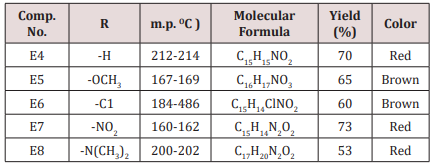
Synthesis of 2-(furan-2-yl)-6-aryl Piperidine-4-one(E4-8)
A mixture of 0.01mol. of ammonium acetate in 30ml. ethanol
was mixed with 0.05mol. of benzaldehyde, 0.05mol. of furfural and
0.025mol. of 2-butanon.The mixture was refluxed for 2h, cooled
and left for 24 h. at room temperature after that 15ml. of conc.
HCl was then added, 20ml. of acetone. The suspended solution
was treated ammonia solution then with water. The sold product filtered
off and crystallized from ethanol physical and IR spectral
data are presented in (Tables 1).
Table 1: Physical properties of compounds E
4-8.
Synthesis of some 1,4-dihydro Pyridine Derivatives
(E9,10)
A mixture of (0.96g, 0.01mol.) furfural, 0.02mol. of (methyl
aceto acetate or acetyl), 0.013mol. of ammonium acetate and 25 ml.
of water. The reaction mixture was stirred at 70o
C for 90 min. After
that ethanol was added. The precipitated compound was filtered
off, dried and crystallized from ethanol, physics and IR spectral data
were as follows: compound 6, mp. 188-190o
C , yield 74% as white
crystals, compound 10 has mp. 177-179o
C, yield 62% as yellow
crystals . The IR spectra of those two compounds showed the
following main absorption bands: 3346-3448cm-1,1705,1697,1653
and 1192, 1099,1219,1122.
Synthesis of some 1,4-dihydro Pyrimidine Derivatives
(E11-14)
A mixture of furfural (2.4g, 0.025mol.), Urea or thiourea
(0.033mol.) and acetyl acetone or methyl acetoacetate ( 0.12 g.,
0.004mol.) of compound (2) was refluxed on 90o
C for 20 min. using
oil bath, cooled, water was added to precipitate the product which
was filtered off and crystallized from ethanol , physical and IR
spectral data were shown in (Table 2).
Table 2: Physical properties of compounds E
11-14.

Synthesis of 2-Methyl-4-(furan -2yl)-6-substituted
phenyl-1,4- dihydro-3-pyridine carboxylate (E15-20)
Ethyl acetoacetate (0.001mol. and compounds E
25-31) each
0.01mol. and 0.01mol. Ammonium acetate were mixed with
compounds (3), (0.05g.) in 5ml. of H
2
O. The final mixture was
refluxed with stirring for the indicated time (Table 5), cooled,
25mol. of dichloromethane was then added , filtered. The filtrate
was evaporated under reduced pressure. The solid product was
recrystallized from ethanol, physical and IR spectral data were
shown in (Tables 3).
Table 3: Physical properties of compounds E
15-20.

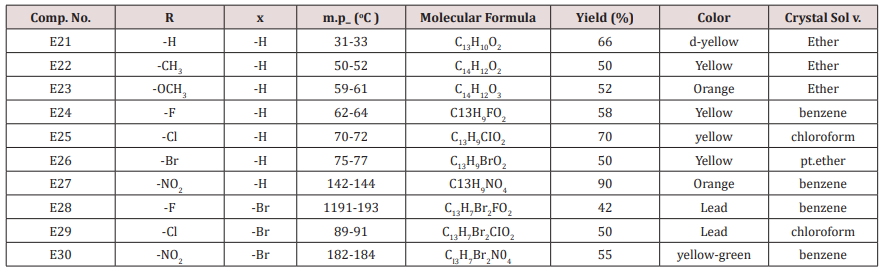
Synthesis of 1-(4-substituted phenyl)-3-(4,5-dibrono
furan-2-yl or furan-2yl)-2-propene-1-one(E21-30)
Furfural or 4,5-dibromo furfural (0.034mol.) and (0.034mol.)
of acetophenone or its substitutes were mixed together and stirred
at 5-15
o
C for 10 min., sodium hydroxide 10% was then added drop
wise. After complete addition, the mixture was stirred for further
3-4 hours. The reaction mixture was left for 24 hours. The solid
ppt. was washed with cold water, physical and IR spectral data are
presented in (Tables 4).
Table 4: Physical properties of compounds E
21-30.
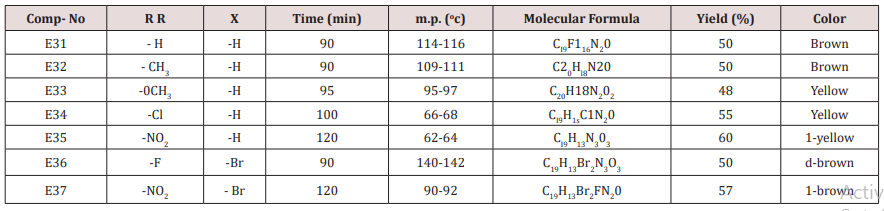
Synthesis of 2-(Furan-2-yl)-4-phenyl -2,3-dihydro
-1H-benzo[b] ,[1,4]-diazepines(E31-37)
Compounds (E13-23), 0.01mol., ortho phenylene diamine
(0.01mol.) were mixed together, cellulose- sulfonic acid (0.01 mol.)
was then added . The reaction mixture was refluxed at 80
o
C for a
given time Tables (10) the reaction was monitored by TLC after
completion it was cooled and extracted with 3x10 of ether. The
combined ether was dried, and the solvent was evaporated under
reduced pressure. The solid product was crystallized from etherethyl
acetate, Physical and spectral data are presented in (Table 5).
Table 5: Physical properties of compounds E
31-37.
Compounds (E
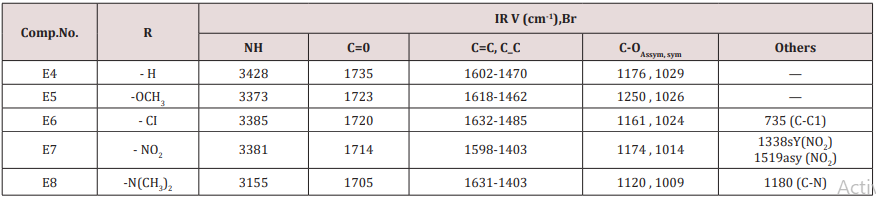
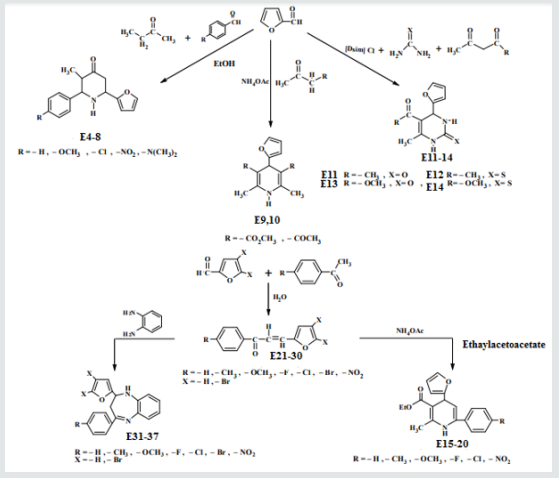
4-8) were prepared from the reaction of furfural
with benzaldehyde or its derivatives in presence of 2-butanone
and ammonium acetate in ethanol as a solvent (scheme 1) .These
compounds were characterized by IR cm-1: 3155-3428 belong to
NH,1705-1735 for C=O while the aromatic appeared at 1632-1662,
C-O sym and assym . absorbed at 1009 and 1176 respectively .
Proton magnetic resonance of compound E5 showed the following
resonating signals ʃppm : 8.64(s) for NH, (m) signal at 7.04-7.06 for
benzene and furan ring (7H) , singlet signal at 3.82 belongs to –OCH
3
of the phenyl substituted (3H), doubled signal at 3.39 and 3.44 for
the CH proton Piperidine ring (2H) while the CH
2
of Piperidine ring
appeared at 2.50ppm. The 1HNMR spectrum of compound E10 was
characterized by the following resonating signals ʃ ppm.: 9.01(s) for
NH proton, 7.40 (d) for 5H of furan ring, 6.24 for 4H of the furan
ring, 5.83 (d) for proton 3 of furan ring , 5.04 (s) for the Piperidine
ring proton, 3.60 for OCH
3
protons and 2.25 (s) for CH
3
(6H) (Table
6).
Table 6: IR spectral data of compounds E
4-8.
Scheme 1.
Compound (E11-14)
This series of compounds were prepared by condensation of
compounds (E
4-8) with Urea, thiourea , acetyl acetone or methyl
aceto acetate using [Dsim] as catalyst(scheme1). The synthesized
compound was characterized by IR (Table 7).
Table 7: IR spectral data of compounds E
4-8.

The first two compounds of this series (E11-12) were
characterized by 1HNMR as follows: For E11 compound (s) signal
at 9.30ppm. Belongs to NH proton, (d) at 7.50ppm. For proton at
position 5 of furan ring, (t) signal at 6.35ppm. fpr proton of position
4 of furan ring, (d) signal at 6.10ppm. For proton of position 3 of
furan ring, (d) at 5.3ppm. For the Piperidine proton, (5) of 3.37ppm.
belongs to C=OCH
3
protons and (d) at 2.23ppm. for CH
3
protons.
While compound E12 characterized by the following resonating
signals ʃppm.: 10.31, 9.7 (s) belong to NH proton, (s) at 7.58 for
position (5) proton of furan ring, (t) at 6.38 for position (4) proton,
(d) at 6.17 for position (3) proton of furan ring, (d) at 5.36 for the
Piperidine proton, (s) at 3.30 assigned to COCH
3 and (s) at 2.20 to
CH
3
equivalent to 3H.
Compounds (E15-20)
This series of compounds were prepared from the condensation
of the corresponding chalcones with ethyl aceto acetate, ammonium
acetate using cellulose sulfonic acid as catalyst. These compounds
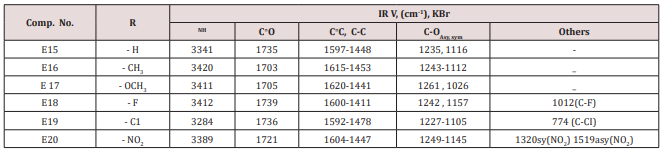
were characterized by the following IR absorption bands; see
(Table 8). This Table revealed the presence of NH absorbed at
3284-3420cm
-1 for NH, 1703-1739cm
-1 for C=C while C-O sym and
assym appeared at 1026-1261cm
-1, see Table 8. 1HNMR spectrum
of compound E16 gave the following resonating signals ʃppm.:
multiplet(m) signal at 7.42,7.59,7.65,7.77,7.82 and 8.07 related to 5
position protons of furan and the aromatic ring protons, NH proton
respectively. Triplet signal at 6.40 belongs to proton of furan ring,
(d) at 6.33 for position 3 proton of furan ring, (d) at 5.00 for proton
5 of furan ring, (d) at 4.63 for Piperidine proton of position 4, (q) at
4.18 for C
2
of ester moiety, (s) at 3.88 for CH
3
of the substituted at
2 position of Piperidine, (s) at 2.50 for CH
3
of ester, 1.94 as double
belongs to CH
3
of ester see.
Table 8: IR spectral data of compounds E
15-20.
Compounds (E<
21-30)
This series of chalcone compounds were prepared from the
condensation of 4,5-di bromo furfural with some acetophenones
(Scheme 1). The synthesized compounds were characterized by IR,
Table. This Table revealed the presence of C=O stretching vibration
at 1660-1697cm
-1, C=C Aliphatic appeared at 1578-1664cm
-1,
while the aromatic C=C absorbed at 1416-1576cm
-1 together with
C-O sym and assym as indicated in (Table 9). These chalcone
compounds were used as starting materials for the preparation of
diazipine compounds by the condensation with ortho phenylene
diamine using sulfamic acid to increase the positive character
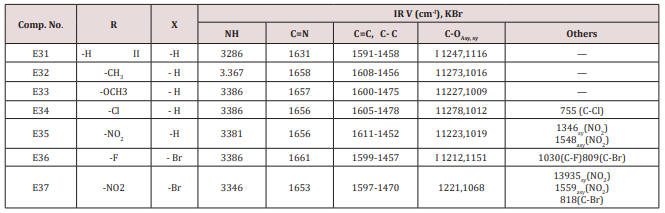
of the carbonyl chalcones. The final(diazipin) compounds were
characterized by the following IR bands cm
-1: 3188-3346 for NH,
1631-1661 for C=N, 1452-1611 for Aromatic C=C stretching, C-O
sym and assym. of 1009-1253, see (Table 10 ). As a representative
sample of this series compound E36 was studied by 1HNMR . The
spectrum showed the following resonating signals: (m) signal at
6.96,7.36 and 7.81 for furan ring protons in which aryl and phenyl
ring protons appeared within the same range, (s) signal at 6.26 for
proton of position 2 of azipine ring, (s) signal at 3.33 for NH, singlet
(s) signal at 2.50 for CH3
which is consider with DMSO signal, (d) at
2.24 belongs CH
2
of a zipine ring protons.
Table 9: IR spectral data of compounds E
21-30.
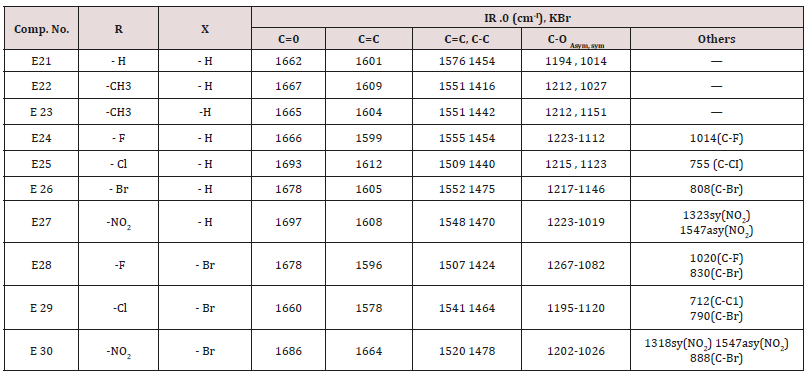
Table 10: IR spectral data of compounds E
31-37.
As it was stated in the introduction part of this work on the
importance of heterocyclic compounds as drugs or co- drug and
especially for those when furyl moiety and nitrogen residue were
part of the whole compound structure .In this investigation we are
focusing on those two important categories, So according to the
resulted data given in the experimental part together with discussed
results we have succeeded in getting these type of heterocyclic
compounds with nitrogen base and at the same time having furyl
moiety from furfural precursors which means more activities for
both type of compounds that becomes two in one final compound
structures, pyridines, pyrimidines and azipines.
Authors would like to thank Iraqi Ministry of Higher Education
and Research for Ibtisam Mohhammad Shaban a Scholarship to do
this work, Thanks also extended to the chemistry Dept and The
Education college of Mosul University for providing the facilities to
do this work which is part of Ibtisam PhD Thesis.